
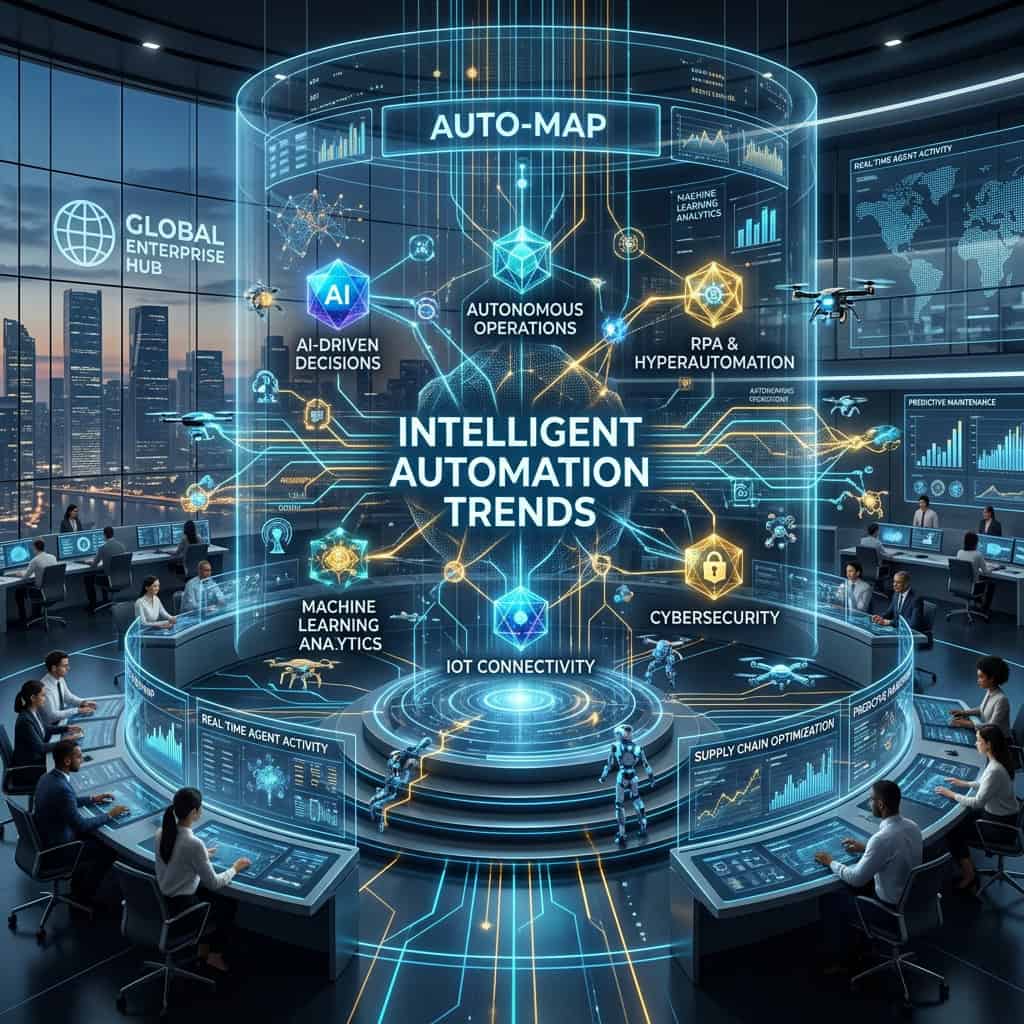
From Process to Strategy: 6 Intelligent Automation Trends Dominating 2026
The year 2026 is seeing a monumental shift in enterprise technology, moving beyond mere process optimization and stepping into the realm of intelligent strategy. Intelligent Automation (IA) is no longer a tactical cost-saving measure; it is the core driver of strategic advantage.
1. Autonomous Multi-Agent Orchestration
Unlike traditional RPA that relies on rigid, rule-based workflows, 2026 has introduced autonomous multi-agent orchestration. Software agents now possess the ability to negotiate, delegate, and collaborate to achieve complex business goals.
The Shift in Enterprise Architecture
Enterprises are redesigning their tech stacks to accommodate agentic swarms. These autonomous units can self-correct when errors occur, ensuring unparalleled resilience.
2. Generative AI as the Cognitive Engine
Generative AI has evolved from a text-producing novelty into the cognitive engine powering enterprise automation. It analyzes unstructured data at scale and makes nuanced decisions.
3. Hyper-Personalized Customer Experiences
With IA, customer service is fully proactive. Predictive analytics combined with real-time generative responses means companies often resolve issues before the customer is even aware of them.
4. Edge Automation and IoT Convergence
Automation is moving to the edge. By integrating IA directly into IoT devices, decisions are made locally with near-zero latency, transforming industries from manufacturing to healthcare.
5. Ethical AI and Governance Frameworks
As AI gains autonomy, governance is critical. 2026 is dominated by built-in compliance frameworks that ensure automation acts ethically and transparently.
6. The Rise of the Automation Strategist
The human role has shifted from managing processes to defining strategic boundaries for automation to operate within. The “Automation Strategist” is now a key executive role.
Conclusion
Intelligent Automation in 2026 is about strategy. Businesses that embrace these six trends are setting themselves up for exponential growth in an increasingly autonomous world.
Leave a Reply